

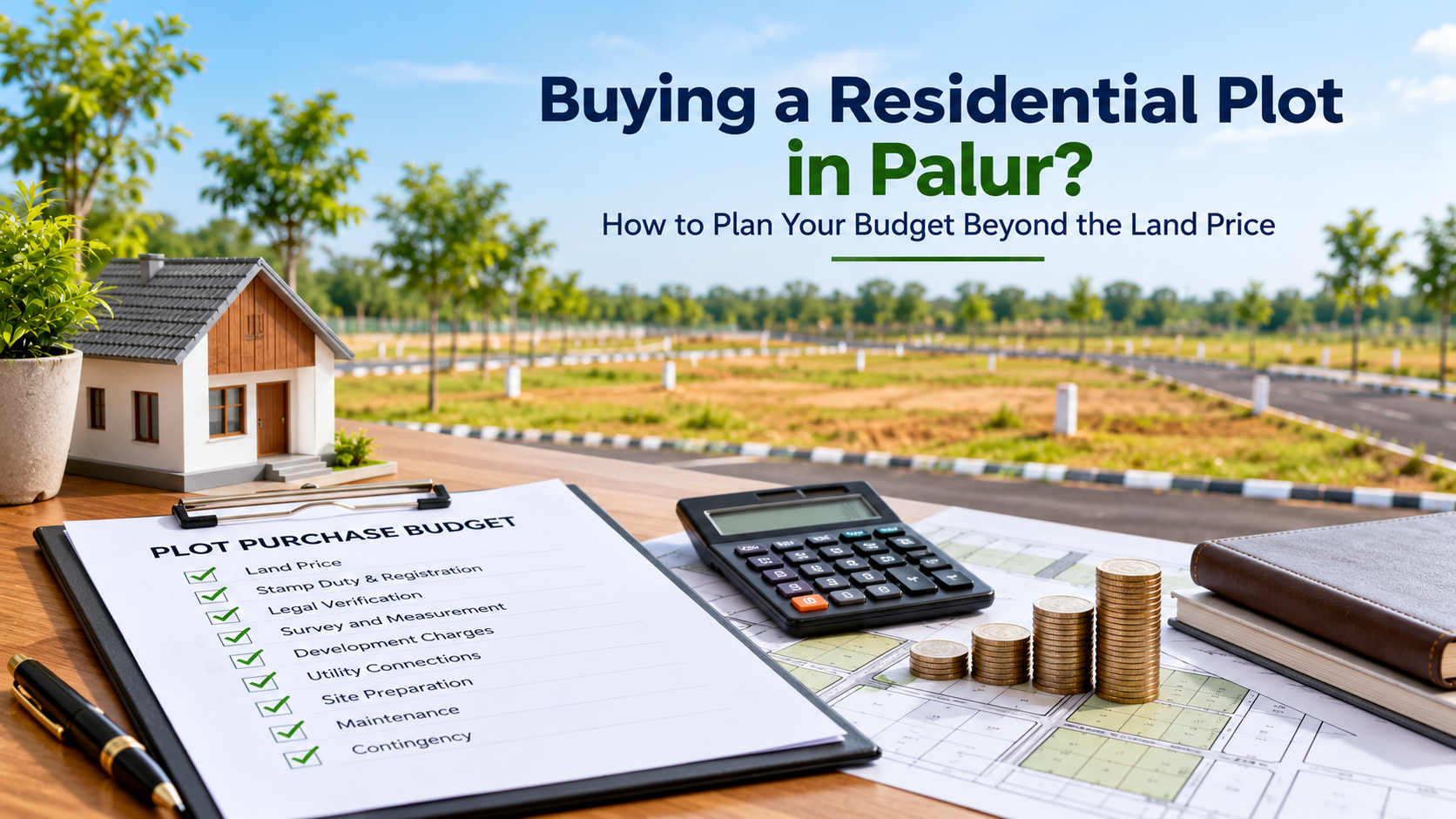


Buying a residential plot is an important financial decision, particularly for families planning to build their own home in the future. While the advertised land price is usually the first consideration, it is not the only expense involved in purchasing property.
For buyers exploring residential plots in Palur, Chengalpattu, understanding the complete purchase cost can help prevent unexpected financial pressure during registration and after ownership transfer.
From stamp duty and registration charges to legal verification, surveying and future maintenance, several expenses may need to be included in your budget.
A well-prepared financial plan allows you to evaluate different plot options based on their overall affordability rather than the quoted price alone.
The first step is to calculate the basic land purchase price.
Residential plots are commonly advertised using a price per square foot. The total land cost depends on the plot area and the agreed selling price.
For example, consider a hypothetical residential plot measuring 1,200 sq. ft. with an assumed selling price of ₹2,500 per sq. ft.
Land Cost Calculation:
1,200 sq. ft. × ₹2,500 = ₹30,00,000
In this example, the basic land price is ₹30 lakh.
However, this amount does not include registration expenses, professional fees or other potential costs.
The figures are illustrative and do not represent the current price of plots in Palur or Gloria Garden.
Stamp duty and registration fees are among the major additional expenses involved in purchasing residential land.
In Tamil Nadu, the amount payable depends on the applicable government rules, transaction type and property valuation.
Buyers should verify the latest charges through the Tamil Nadu Registration Department before calculating their final purchase budget.
For a typical sale deed, commonly referenced rates are 7% stamp duty and 4% registration fee, subject to applicable rules, concessions and valuation requirements.
Using a hypothetical assessable property value of ₹30 lakh:
| Expense | Illustrative calculation | Amount |
|---|---|---|
| Stamp duty | 7% of ₹30,00,000 | ₹2,10,000 |
| Registration fee | 4% of ₹30,00,000 | ₹1,20,000 |
| Total | 11% | ₹3,30,000 |
This illustration assumes the full stated rates apply to the assessed value. Actual charges may differ, and the value used for registration may not be identical to the negotiated selling price.
Always confirm the current payable amount through the official registration process.
Before purchasing a residential plot, it is advisable to have the property's legal documents independently reviewed.
A qualified property lawyer can help examine ownership history, title documents and potential legal concerns.
Important documents may include:
Parent deeds and title documents
Encumbrance Certificate
Patta and relevant revenue records
Approved layout plan
Survey number and subdivision details
Applicable DTCP approval information
Relevant RERA registration details, where required
Sale agreement and draft sale deed
Professional verification involves an additional expense, but it can help buyers identify issues before completing the transaction.
The fee will depend on the professional and the scope of verification.
Plot measurements should be checked carefully before registration.
The dimensions shown in marketing materials or layout drawings should be compared with the relevant approved records and actual site boundaries.
A qualified surveyor can help verify:
Plot dimensions
Boundary positions
Survey references
Road alignment
Possible measurement discrepancies
If a survey is required, include the professional fee in your purchase budget.
This is particularly useful when purchasing land for future independent house construction.
When evaluating plotted developments, buyers should understand which infrastructure-related expenses are included in the quoted price.
Depending on the project and agreement, certain development-related charges may be included or billed separately.
Ask the seller for written clarification regarding:
Internal road development
Street lighting
Drainage arrangements
Water-related infrastructure
Electricity connection provisions
Common-area development
Any applicable maintenance contributions
Do not assume that every facility is included simply because it appears in promotional material.
Review the sale agreement and supporting documents to understand the seller's commitments and any additional charges.
Buying a plot and constructing a house are separate stages of financial planning.
If you intend to build a home later, consider the potential costs of obtaining utility connections.
Depending on the property's location and available infrastructure, future expenses may involve:
Electricity service connection
Water supply arrangements
Plumbing and storage systems
Wastewater disposal arrangements
Internal wiring and electrical installation
Connection availability, charges and technical requirements should be verified with the relevant service providers.
These expenses may not arise immediately after plot registration, but they should be considered when preparing a long-term home construction budget.
Not every residential plot will require the same amount of preparation before construction.
Some sites may need additional work depending on their ground conditions, elevation and intended building design.
Potential expenses include:
Clearing unwanted vegetation
Removing debris
Site surveying
Soil investigation
Ground preparation
Engineering assessments
Approved filling or levelling work, where necessary
Avoid carrying out substantial filling or altering natural drainage without obtaining appropriate professional advice and any required permissions.
A site inspection and qualified assessment can help determine which expenses are genuinely necessary.
If you are purchasing land now and planning to build a home after several years, ongoing plot maintenance may be required.
Vacant land should be inspected periodically to ensure that its boundaries remain identifiable and the site is maintained appropriately.
Possible expenses include:
Periodic vegetation clearing
Boundary marker maintenance
Fencing, if required and permitted
Site inspections
Removal of dumped waste
Maintenance of temporary protective measures
The actual cost depends on the plot's size, location and maintenance requirements.
Setting aside a small annual budget can help you manage these responsibilities without unexpected expenditure.
Land ownership may involve certain recurring statutory obligations.
The applicability and amount of property-related taxes or local charges depend on the property's classification, jurisdiction and relevant local authority rules.
Before purchasing a plot in Palur, verify which local body has jurisdiction over the property and whether any taxes or charges apply.
Keep records of payments and ownership documents organised for future reference.
Some buyers may consider a plot loan to finance their purchase.
Loan eligibility, interest rates, repayment periods and margin requirements vary between financial institutions.
In addition to the principal and interest, borrowers may encounter expenses such as:
Loan processing fees
Property valuation charges
Legal verification fees
Applicable documentation charges
Insurance costs, where relevant
Other lender-specific charges
Before selecting a loan, compare the total borrowing cost rather than focusing only on the advertised interest rate.
Also confirm whether the lender finances the particular type of residential plot you intend to purchase.
A simple itemised budget can help buyers understand the financial commitment involved.
The following example assumes a residential plot with a negotiated price of ₹30 lakh.
| Expense category | Illustrative budget |
|---|---|
| Basic land price | ₹30,00,000 |
| Stamp duty (assumed 7%) | ₹2,10,000 |
| Registration fee (assumed 4%) | ₹1,20,000 |
| Legal verification | ₹15,000 |
| Survey and measurement | ₹8,000 |
| Initial site maintenance provision | ₹12,000 |
| Contingency reserve | ₹35,000 |
| Estimated total budget | ₹34,00,000 |
Important: This is a hypothetical planning example, not a quotation for Gloria Garden or an estimate of actual transaction charges. The professional fees, maintenance provision and contingency are assumed amounts. Development charges, financing costs, applicable taxes and future construction expenses are not included.
The example demonstrates how a ₹30 lakh land purchase could require a larger overall budget.
Buyers should obtain current written quotations and official fee calculations before committing to a property.
Many families purchase residential land several years before beginning construction.
In such cases, it is useful to maintain two separate financial plans.
Plot purchase budget
This covers the land price, registration expenses, legal verification, surveying and other immediate transaction costs.
Future construction budget
This covers architectural design, building approvals, soil testing, foundation work, construction materials, labour, utility connections and finishing.
Keeping these budgets separate can help you avoid using funds intended for future construction to meet unexpected purchase expenses.
First-time buyers may underestimate the total cost of purchasing a residential plot.
Some common mistakes include:
Calculating affordability using only the advertised plot price
Not verifying current registration charges
Overlooking legal and surveying expenses
Assuming all development costs are included
Failing to budget for future maintenance
Ignoring loan processing and financing costs
Not maintaining a contingency reserve
Paying advances before completing essential verification
A detailed written cost breakdown can help reduce these risks.
Before making a payment, request clarification about all charges and ensure that important terms are properly documented.
For buyers considering residential plots in Palur, Chengalpattu, Gloria Garden – DTCP & RERA Approved Plots in Palur is a plotted development worth exploring.
When evaluating a plot at Gloria Garden, begin by understanding the available plot dimensions, current selling price and applicable payment terms.
Ask for a complete written breakdown of the purchase expenses, including any charges that may apply in addition to the quoted land price.
Buyers should also independently verify the relevant approvals, RERA registration status, title documents, layout details and survey measurements before completing the transaction.
If you are purchasing land for future home construction, consider how the plot's dimensions, access and physical conditions may influence your longer-term building budget.
This approach can help you evaluate the property based on its complete financial commitment rather than its initial price alone.
Before finalising a residential plot purchase, review the following:
Have you calculated the total land price using the agreed plot area and rate?
Have you verified the current stamp duty and registration charges?
Have you budgeted for independent legal verification?
Do you need a professional land survey?
Are all development-related charges clearly documented?
Have you checked whether financing expenses apply?
Have you considered future utility connection costs?
Is there a budget for maintaining the plot before construction?
Have you separated your land purchase and house construction budgets?
Do you have a reasonable contingency reserve for unexpected expenses?
Completing this checklist can help you approach the purchase with greater financial clarity.
Buying a residential plot in Palur involves more than selecting a suitable location and agreeing on a price per square foot.
Registration charges, legal verification, surveying, site preparation and future maintenance can all influence the total financial commitment.
For buyers exploring residential plots in Palur near Chengalpattu, preparing an itemised budget is an important part of making a well-informed purchase decision.
By reviewing the complete cost, verifying property documents and planning separately for future construction, families can approach land ownership with greater confidence.
Whether you are purchasing land for an independent home or considering a long-term residential property, careful financial planning can help you evaluate opportunities such as Gloria Garden with Value Realitty.
Back


144, Bharathamadha Street, East Tambaram, Tambaram, Chennai, Tamil Nadu 600 059.