

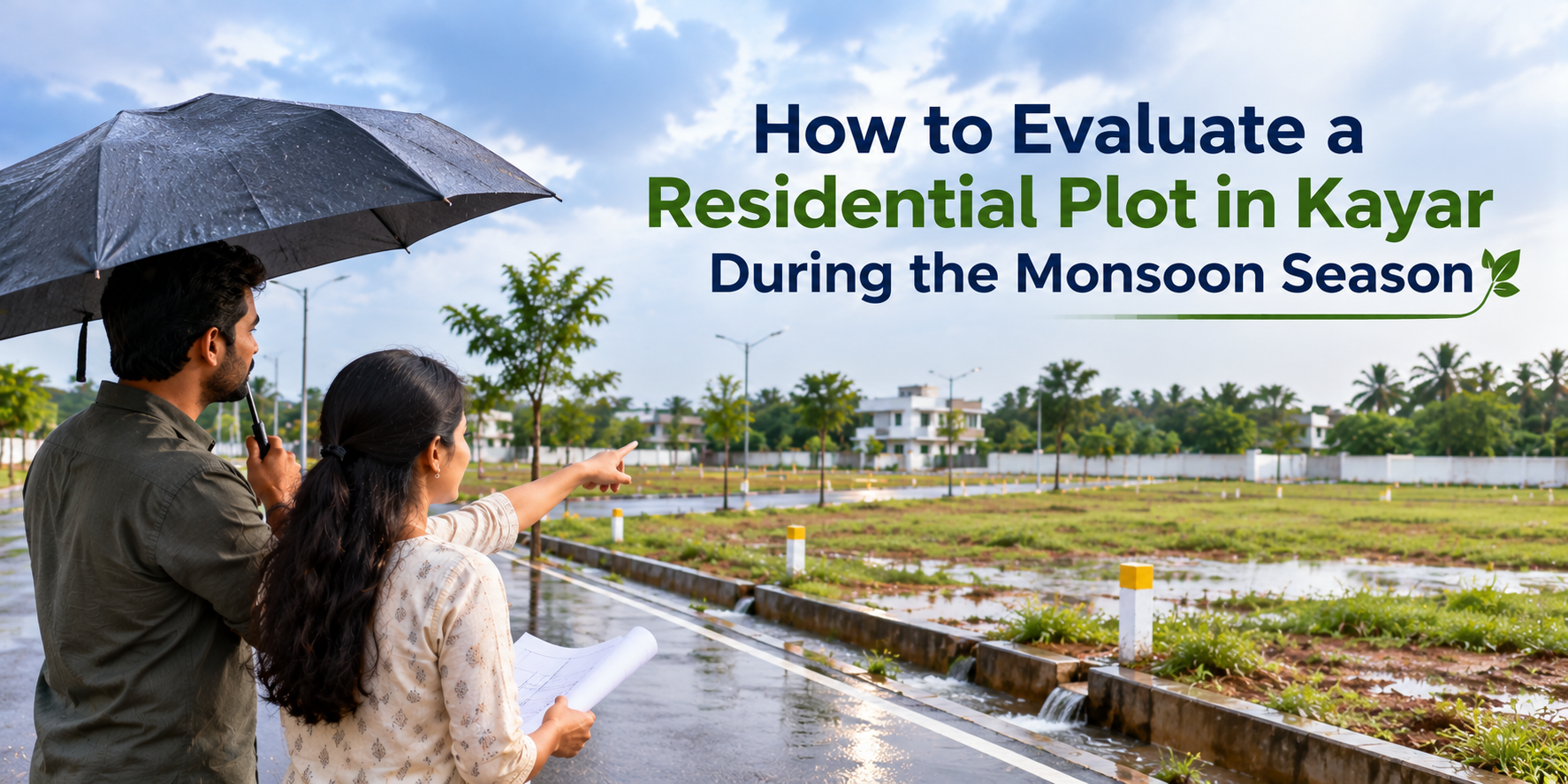


Buying a residential plot involves more than checking its location, dimensions and price. Seasonal conditions can also influence how suitable a property may be for future home construction. In Chennai and its surrounding areas, the monsoon season provides an opportunity to understand how land, roads and drainage systems respond to heavy rainfall.
For buyers exploring residential plots in Kayar near OMR, observing a property during or shortly after rainfall can reveal details that may not be visible during dry weather. Ground levels, rainwater movement, road accessibility and surrounding drainage conditions are all worth examining before making a decision.
Whether you are purchasing land to build a home immediately or planning construction several years later, a careful monsoon-season site inspection can help you make a more informed choice.
A residential plot may appear level, accessible and well-maintained during summer. However, rainfall can reveal how water moves across the property and the surrounding neighbourhood.
During the monsoon, buyers may notice temporary water accumulation, uneven road surfaces, blocked drainage channels or changes in access conditions.
These observations do not automatically indicate that a property is unsuitable. However, they can help identify issues that require further investigation.
When evaluating plots in Kayar, consider visiting the location under different weather conditions rather than relying on a single inspection.
One of the first things to examine is the plot's elevation relative to the surrounding roads and neighbouring properties.
A plot situated below the adjacent road level may require additional investigation into how rainwater enters and leaves the site.
During your visit, observe:
Whether the plot is higher or lower than the approach road
The direction in which rainwater naturally flows
Differences in ground level between neighbouring plots
Any visible signs of soil erosion
Areas where water appears to collect
If the plot has been filled or levelled, ask about the work carried out and whether appropriate engineering assessments are available.
A qualified engineer can help determine whether additional site preparation may be necessary before construction.
Visiting a plot after rainfall can provide useful information about surface drainage.
Look for standing water within the plot, along its boundaries and on nearby roads.
Pay attention to whether water appears to drain naturally or remains in particular areas.
However, a single visit cannot establish the property's complete drainage history. Water accumulation depends on rainfall intensity, duration, ground conditions and the surrounding drainage network.
If you notice significant standing water, consider arranging a professional assessment before proceeding.
Road accessibility is particularly important during the monsoon season.
Even if the plot itself appears suitable, poor access roads can create inconvenience for future residents and construction vehicles.
When inspecting residential plots near OMR, observe the condition of both the internal layout roads and the roads connecting the development to nearby main routes.
Check for:
Water accumulation along road edges
Potholes or damaged surfaces
Uneven road levels
Adequate vehicle movement
Roadside drainage arrangements
Accessibility after heavy rainfall
It is useful to understand whether the approach roads remain practical for everyday travel during different seasons.
A plot's drainage conditions are influenced by more than the land within its boundaries.
Rainwater may flow from neighbouring properties, roads and higher ground towards lower-lying areas.
During your site visit, observe any visible roadside drains, natural drainage paths and nearby channels.
Ask whether the surrounding area has an established system for managing stormwater.
If drainage infrastructure is planned but not yet completed, seek clarification about its current status rather than assuming that future work will resolve existing conditions.
Before purchasing land, it is useful to understand the surrounding geography.
Identify whether there are lakes, ponds, streams, canals or other natural drainage features near the property.
Their presence does not automatically mean a plot is flood-prone. However, proximity to water bodies can make it important to examine local topography, drainage routes and applicable development restrictions.
Buyers can consult available government maps, planning records and other official information to better understand the site's surroundings.
Where necessary, seek professional advice about potential flood exposure and land-use restrictions.
Local observations can provide useful context when evaluating land during the monsoon.
If possible, speak with nearby residents, shopkeepers or property owners who have experienced several rainy seasons in the area.
You may ask:
Does water accumulate on the surrounding roads during heavy rainfall?
How quickly does standing water usually drain?
Have there been any significant access difficulties?
Are nearby roads regularly maintained?
Have drainage conditions changed following new construction?
Treat these conversations as supporting information rather than conclusive evidence.
Important claims should be cross-checked with official records or qualified professionals where appropriate.
Heavy rainfall can sometimes expose loose soil, erosion or uneven ground conditions.
During your inspection, observe whether soil has been washed away near plot boundaries or road edges.
You should also look for visible depressions, cracks or areas where the ground appears unstable.
These observations alone cannot determine whether land is suitable for construction.
If you are planning a house, a qualified geotechnical professional can assess soil characteristics and recommend appropriate foundation considerations.
The type and condition of soil can influence foundation design, drainage planning and construction methods.
A visual inspection is not a substitute for a professional soil investigation.
Depending on the proposed building and site conditions, an engineer may recommend appropriate soil testing before finalising the structural design.
This can help identify relevant ground characteristics and inform foundation planning.
Buyers planning an independent home in Kayar should allow for necessary site investigations within their construction budget.
Rainfall can sometimes affect temporary boundary markers, fencing or exposed soil around a plot.
During your visit, check whether the plot boundaries remain clearly identifiable.
Compare the visible boundaries with the approved layout plan and relevant property measurements.
If there is uncertainty about the location or dimensions of a boundary, seek assistance from a qualified surveyor.
Accurate boundary identification is important regardless of the season in which the property is purchased.
Nearby construction can influence surface water movement.
For example, newly raised ground levels, compound walls and changes to roads may alter how rainwater flows through a neighbourhood.
When visiting a plotted development, observe the surrounding properties and any ongoing construction activity.
Consider whether the neighbourhood has established drainage arrangements and whether nearby development could affect access or water movement.
Avoid making assumptions based solely on the number of existing houses.
A proper assessment should consider the site's actual physical conditions.
A single site visit may not provide enough information to understand seasonal conditions.
If possible, inspect the plot:
During normal dry weather
After moderate rainfall
Following a period of heavier rainfall, when it is safe to travel
Comparing observations across different visits can help you understand changes in ground conditions, drainage and accessibility.
Do not enter flooded areas or attempt to inspect a property during unsafe weather conditions.
In addition to physical inspections, buyers can consult relevant official information about the locality.
Depending on availability, useful sources may include:
Approved layout plans
Local planning authority records
Revenue and survey records
Government flood-risk information
Drainage-related public records
Applicable land-use restrictions
Official records and professional assessments can help buyers evaluate concerns that cannot be resolved through observation alone.
It is also advisable to have ownership documents and planning approvals independently verified before purchasing land.
For buyers considering residential plots in Kayar, Magnora Serasa – Residential Plots Near OMR is one plotted development worth exploring.
Located in the Kayar area near Thiruporur, Magnora Serasa is positioned within the wider OMR residential corridor.
Buyers considering the project can use a monsoon-season site visit to examine the plot levels, internal roads, approach roads, visible drainage arrangements and surrounding ground conditions.
It is also useful to review the approved layout information, available plot dimensions, infrastructure details and applicable documentation.
Before purchasing, independently verify the property's legal status, approvals, measurements and site conditions. Where drainage or soil-related concerns arise, seek advice from appropriately qualified professionals.
Before shortlisting a residential plot in Kayar, use this practical checklist:
Check the plot's ground level relative to the road.
Observe whether rainwater accumulates within the site.
Examine the internal road condition.
Inspect the approach road after rainfall.
Identify visible drainage arrangements.
Check nearby water bodies and natural drainage channels.
Look for signs of erosion or uneven ground.
Speak with people familiar with local monsoon conditions.
Compare the physical plot with the approved layout.
Review available official information and obtain professional advice where necessary.
Recording these observations can make it easier to compare multiple properties before making a final decision.
The monsoon season can provide valuable information for people planning to purchase residential land. Rainfall may reveal drainage patterns, road conditions and ground-level differences that are less noticeable during dry weather.
For buyers exploring plots in Kayar near OMR, a careful site inspection should include the property itself as well as the surrounding roads, drainage arrangements and neighbourhood conditions.
However, visual observations should be supported by appropriate document verification and professional assessments whenever necessary. No property should be assumed to be free from flooding or drainage concerns without reliable evidence.
By evaluating land across different weather conditions, buyers can make more informed decisions about their future home plans.
For those exploring residential opportunities around Kayar and Thiruporur, Value Realitty offers plotted developments such as Magnora Serasa that can be assessed through a detailed site visit and independent verification before purchase.
Back


144, Bharathamadha Street, East Tambaram, Tambaram, Chennai, Tamil Nadu 600 059.